Designing the city
An interview with Prashant HedaoBy Alan and Lesley
Keywords: Master Plan (Perspective 2025), Galaxy model, Crown Road, Auroville Town Development Council (ATDC) / L’Avenir d’Auroville, Darkali forest park, Participatory planning, Mobility and Village relations
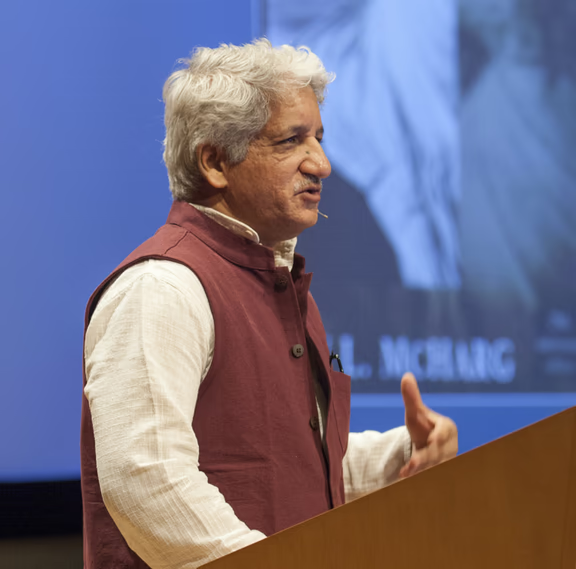
Prashant
Auroville Today: What is your conception of the Crown?
Prashant: For a circular city plan like ours, a road connecting the four zones is needed. I don’t think many people have a problem with the Crown, it is how and when it is to be implemented that needs to be discussed. In a recent General Meeting, one of the Town Development Council (TDC) members admitted that the present Crown section from the Solar Kitchen to Arka was poorly planned because it has only increased high-speed traffic. He said they want to learn from this, and not repeat it. But then they tell us it has to be a perfect circular road of 6.7 metres width, which is almost double the width of the present road. So what have they learned from that mistake?
How would you design the Crown?
It needs to be done differently in different sections. The Solar Kitchen – Arka stretch has to be more pedestrianised, so it needs more plazas, and reduced vehicular traffic. If the present section from the Gaia junction to Matrimandir/Town Hall is closed to vehicular traffic, then automatically the traffic on this side of the town (which is largely residential) would be reduced and most traffic will be diverted to the other side.
The section from PTDC to Savitri Bhavan doesn’t need a new road as we already have a road that serves that connection, but a cycle path would be a brilliant idea. When the population of the city grows beyond say 15,000 and we have more densification, we could think of the road there, but right now it’s not necessary. If we make a road now from PTDC to Savitri Bhavan, that road will be largely used by village traffic, exploratory tourists, and will also attract other elements that indulge in alcohol picnics, and other such activities. Basically we will be opening up more Auroville lands for outsiders and the road won’t really benefit us
The way through Darkali forest is also not recommended at this time, not even a cycle path because of its proximity to Kottakarai village: Darkali already has issues with alcohol picnics, and other anti-social activities. In future when we have sorted out these issues and how we interface with villages, it could be a narrower road, with no buildings on either side, an experience of a low impact road through a forest. This is something which Roger himself agreed to, although he also said this would depend on how and when the International Zone develops.
A road through Bliss forest would split the forest. There are, of course, roads through national parks in other parts of the world, but they are tightly controlled with check posts and limits upon when traffic could use it. And, besides, a road through Bliss is not really needed because there is an existing road which goes around it. Only if you are stuck on symbolism you want it to go through there.
Are you referring to some people’s belief that the Crown should be perfectly circular?
Yes. But there’s nothing geometrical about the Galaxy. I have tried very hard but I could not find any geometrical pattern in it, such as the curves of the radial roads or the distance between them, and the zones are not the same size or shape. But this hasn’t stopped the planners. The 1999 Master Plan has twelve curved radial roads to divide up the city. When I asked why they had done this, someone admitted it was based on Mother’s symbol. But if a road is a symbol, it also has to be functional too: it should solve problems, not add to them. And it begs a question. If we are primarily going to be a cycling and pedestrian city, do we really need all these wide roads which are more inviting to fast motorized vehicular traffic?
If you define the Crown as a road with a wide right-of-way with buildings setbacks on either side, which is the present plan, you cut off the central part from the outer parts of the city. In other words, you are doing the opposite of defining the Galaxy because the Galaxy is an interconnected flow, while the roads (with their right of way and building setbacks) split it into pieces.
So what are the options for improving mobility in a city?
Generally, in a city public transport is a good solution, but you need sufficient numbers of people to make it viable. At present, we are not close to those numbers. The Visitors Centre pick up service is one of our solutions at present for residents who don’t want to drive and are willing to wait, especially at night.
What about the thousands of others – workers, tourists, construction traffic etc. – who also use our roads every day? What kind of mobility plan can handle them?
Mobility can be targeted in different ways. I think tourism is managed by the Visitors Centre quite well at present because tourists park their vehicles there, and then they walk or take the electric shuttle to go to Matrimandir viewpoint. What we can’t control are individual tourists wanting to come inside Auroville on two wheelers, because you can’t put barriers on every access. This is not a long-term solution.
Regarding workers, we need to know at which points they enter Auroville. Once we know this, we could plan a shuttle service at peak hours and this can probably take care of 50% to 60% of that traffic. But this is possible only if we have the numbers, and a place for them to safely park their private vehicles.
So what is the long-term mobility solution?
We will need to provide some access to Auroville from outside, but it should be done at the right time and in a phased manner. And we shouldn’t be constructing all sections of the outer ring road.
I don’t think the current conception of an outer ring road is a good idea because again you create a racetrack, and the four roads connecting with it would create an inviting bypass for heavy traffic to cross over between the Tindivanam and the ECR roads to avoid paying toll charges.
The problem is the present TDC approach to planning which says, ‘Let’s build it as per the approved Master Plan of 1999 and then we’ll figure out how to solve the problems it creates’. That’s a very dangerous way to do planning.
The TDC is in a hurry to manifest the Crown now? Do you agree with this approach?
Not at all. This is not a city we should build in a hurry. If we really wanted to build it fast, we should bring in the Chinese. But, in the process, a lot of things would be left out which need to be considered.
Such as?
This brings us back to the basic question, what is a city? Some people think a city is just infrastructure and buildings. That is the physical part, but there are also the socio-economic, ecological aspects and the institutions which are created and, most importantly for us, the spiritual aspect. Everything we do here has a very strong spiritual connection to it, so how do we manage to keep that connection in an urban environment? How can such an environment support the spiritual aspirations of the individual and the collective?
All these things put together form a city. But if you only look at one aspect, you are missing out on a whole bunch of others.
So I think our city will happen, but not in the way that people in the current TDC and their supporters envisage it. And I’m not sure it will ever be completed.
The argument that we should build the city first and that will attract the people doesn’t make sense, because how would you ensure that the right people are attracted here? Where we should be putting our energies is in supporting activities, building institutions, which would attract the right kind of people to come here.
Do you feel city planning should be participative, involving the larger community?
Yes, but this has been sacrificed at present. Currently, the Secretary has given the TDC more power than they could ever have dreamt of, and they were co-opted by certain interests who are not interested in participatory planning, so it’s not surprising. But I think this is a passing phase from which we will learn a lot.
Actually, participatory planning is a challenge for everybody in the world. The way planning happened in the world in the 1960s was a master plan was made and that was built; there was no wider participation because it was believed that it was a job for experts. But the outcome was not good: we had cities with monumental buildings but they were not the most livable cities. Around the 1980s, as we got more knowledge about the environment, communities, and social interactions, it was realised that the planners need feedback from ordinary people.
But still it was only feedback; ordinary people were not involved in the actual planning. However, today it is felt the people have to be around the planning table as equal partners. But how do you manage this? So planners are organizing workshops and artists, poets, eminent personalities, are getting involved to make people aware of different aspects of the city, and the emphasis is upon transparent communication.
What needs to happen in Auroville to make participatory planning more effective?
Firstly, we have to identify people whose voices we don’t hear at present. Not everybody is comfortable in speaking in a General Meeting or in a public forum. We have to explore other ways for the not so visible section amongst us to contribute their views. There would definitely be issues they would bring in that the planners have not thought about and which need to be integrated. Traditional knowledge is also very important in planning, and we haven’t really tapped into this. In the end, everybody potentially has a role to play in planning this city. It’s hard work and time consuming providing the right platform, finding the right information and jointly coming up with solutions, but it needs to be done to make this an inclusive, sustainable city.
But some people argue that Mother has already given the guidelines – she is the client, not us – and all we need to do is manifest them.
Yes, I’ve come across this version, but in what sense can this ever be participatory? As I told one of the proponents, if you hold this view, you don’t even need planners. All you need is contractors to manifest what you think is the plan.
But do we have the competence in Auroville to do integral participatory planning in the way you are suggesting?
I think we have some competence, but not one hundred percent. I don’t know that we have the capability to make a detailed development plan (DDP), probably we do. One thing to remember is that you don’t do a DDP for the whole city in one go. You do it for areas that you want to develop at that time, and you arrive at it after extensive consultations. We could get some help from outside; we have a lot of goodwill outside from the architecture community in India and many of them have expressed their interest to help. But whoever helps us will have to actively collaborate and interact with Aurovilians, because there’s something special about Auroville that needs to be conveyed and integrated in such a plan.
What about people like you and others who have a lot of planning experience. Do you feel that your input is being incorporated in Auroville planning at present?
No, it is not.
Why not?
Because the present TDC is talking about a symbolism in planning the city, based on a certain geometry like a perfect circle, which they will build first. And only then figure out how to solve problems like getting people to confine themselves to travelling a maximum of 15 kilometres an hour on the Crown, or ensuring there is sufficient water.
We want to look at these things along with manifesting the Galaxy, not later, which is why we are treated as outsiders.
How could people like you be meaningfully involved?
Only if there is a shift in the balance between the symbolism and taking into account the ground realities and the real problems of mobility, water, regional connectivity, ecology, environment, etc.
There are competent people who are sidelined right now because in the planning group the balance is very heavily on the side of symbolism.
But I also see positives in the present Crown controversy. It has shaken up the community and reconnected many people through their concerns. And because the Youth Centre is in the middle of this, the youth have become very active. We made a presentation to them on planning and they were enthusiastic: some of them even expressed that they want to become planners. Some schoolchildren are also getting involved. Our effort is that they become informed citizens and don’t make decisions based solely on perceptions.
All this is very positive. In future, it will make it more difficult to impose a simplistic planning solution because now the community is much more active and knowledgeable.
Do you feel that people like yourself bear some responsibility for the present rush to complete the Crown, because there seems to be a fear in one section of the community that you are anti-Galaxy, and if they don’t do something now, it will never happen.
Partly I agree, although I didn’t take these labels very seriously, despite hearing some people refer to people like us as the ‘anti-Galaxy gang’. It’s wrong because the anti-Galaxy bit is a narrative propagated by the people who have no clue about how to manifest it. We have tried to make it very clear that we are not against the Crown or the Galaxy. We are just trying to marry them in a logical way and make the whole concept more beautiful and functional at the same time.
And we’re not alone in wanting to do this. One eminent Indian architect said the Galaxy is a beautiful concept, and we should not do anything that takes away the beauty of it. He felt you should not perceive the Galaxy only from above, from a bird’s eye view, but that the beauty, the dynamism, should also be experienced every time you move through different parts of the city.
The great Indian architect, Balakrishna Doshi, is also fascinated by the Galaxy and by Auroville because of the possibility for experimentation here: nowhere else in India can you get this. He actually said that building Auroville is an ongoing experiment.
He also said we must not forget the regional connection with Auroville, and the particular challenge of how we interface the villages with Auroville. At the moment, one of the proposed lines of force ends eighteen stories high next to Edayanchavady village! This is why he remarked that Auroville cannot develop unless you also develop the villages.